

When I talk to founders at BizFromZero, this is the question that comes up more than any other: “Should I be an LLC, S-Corp, or C-Corp?”
And I get it. Choosing the right business structure feels like one of those decisions where you could either save thousands of dollars or accidentally cost yourself money for years.
Here’s what I want you to understand before we go deeper: there is no single “best” structure. The right choice depends entirely on your profit level, growth plans, and what you’re trying to build.
I’m Satyajit Srichandan, founder of BizFromZero. I’ve been on this journey myself — learning about business structures, making mistakes, and figuring out what actually matters when you’re building from zero. This guide is everything I wish someone had told me when I was trying to understand the difference between these structures.
In this guide, I’m going to walk you through the tax differences between LLC, S-Corp, and C-Corp structures in simple language. No jargon. No exaggerated claims about “massive tax savings.” Just clear, practical information to help you make an informed decision.
This article is for educational purposes only and not tax or legal advice.
What Is an LLC?
Let’s start with the simplest structure: the Limited Liability Company (LLC).
An LLC is a legal business structure that protects your personal assets from business debts and lawsuits. It’s the most common structure for small business owners because it’s simple to set up and flexible to manage.
How LLCs are taxed:
By default, an LLC is what’s called a “pass-through entity.” This means:
- The business itself doesn’t pay federal income tax
- All profits “pass through” to you, the owner
- You report the income on your personal tax return
- You pay both income tax AND self-employment tax on the profits
Single-member LLC vs multi-member LLC:
- Single-member LLC: The IRS treats you like a sole proprietor for tax purposes. You file Schedule C with your personal tax return (Form 1040).
- Multi-member LLC: The IRS treats you like a partnership. The business files Form 1065, and each member gets a Schedule K-1 showing their share of the profits.
Self-employment tax:
This is the big thing most new LLC owners don’t expect. If you make $80,000 profit in your LLC, you’ll pay:
- Regular income tax (based on your tax bracket)
- PLUS 15.3% self-employment tax on that $80,000
The 15.3% breaks down as:
- 12.4% for Social Security (on earnings up to $176,100 for 2024; $184,500 for 2026)
- 2.9% for Medicare (no cap)
- An additional 0.9% Medicare tax on earnings over $200,000 (single) or $250,000 (married filing jointly)
This self-employment tax catches a lot of people off guard. It’s essentially the employer + employee portions of payroll tax that W-2 employees split with their employer.
What Is an S-Corp?
Here’s something important: an S-Corp is not a legal business structure. It’s a tax election.
You don’t “form” an S-Corp. You form an LLC or a corporation, then you elect to be taxed as an S-Corp by filing Form 2553 with the IRS.
How S-Corp taxation works:
When you elect S-Corp status, your business is still a pass-through entity (like an LLC), but with one key difference:
You can split your income into two parts:
- W-2 salary (subject to payroll taxes)
- Distributions (NOT subject to self-employment tax)
This is where the tax savings come from.
The reasonable salary requirement:
The IRS requires that you pay yourself a “reasonable salary” for the work you do. You can’t pay yourself $20,000 when comparable positions earn $80,000 — that’s a red flag for an audit.
What’s “reasonable” depends on:
- Your industry
- Your role and responsibilities
- What similar positions pay in your market
- Your company’s revenue and profitability
There’s no official IRS formula. The commonly referenced “60/40 rule” (60% salary, 40% distributions) is a myth — it has no basis in IRS guidance. The IRS wants market-rate compensation, period.
How to elect S-Corp status:
File Form 2553 with the IRS. The deadline is strict:
- For calendar-year businesses: March 15 (or March 17, 2026, since March 15 falls on a Sunday)
- For new businesses: Within 2 months and 15 days of formation
- You can also file any time during the previous tax year
If you miss the deadline, you might qualify for late election relief under IRS Revenue Procedure 2013-30, but it requires reasonable cause and proper documentation.
What Is a C-Corp?
A C-Corp is a traditional corporation — a completely separate legal entity from its owners.
Unlike LLCs and S-Corps, a C-Corp is NOT a pass-through entity. It pays its own taxes.
How C-Corp taxation works:
C-Corps face what’s called “double taxation”:
- Corporate level: The company pays 21% federal corporate income tax on profits
- Shareholder level: When you take profits out as dividends, you pay personal income tax on those dividends (0%, 15%, or 20% depending on your income)
Example of double taxation:
Your C-Corp makes $100,000 profit:
- Corporate tax (21%): $21,000
- Remaining after corporate tax: $79,000
- You distribute $79,000 as a dividend
- Dividend tax (let’s say 15%): $11,850
- You keep: $67,150
Total taxes paid: $32,850 (32.85% effective rate)
Compare that to an S-Corp or LLC, where you’d pay once at your personal rate.
When C-Corp makes sense:
Despite double taxation, C-Corps have advantages:
- Venture capital: VCs strongly prefer (and often require) C-Corps
- QSBS benefits: Qualified Small Business Stock (Section 1202) can exclude up to $15 million in capital gains when you sell (increased from $10 million under the One Big Beautiful Bill Act of 2025)
- Reinvesting all profits: If you’re not taking distributions, the 21% corporate rate might be lower than your personal rate
- Unlimited shareholders: Unlike S-Corps (max 100), C-Corps have no limit
- Foreign investors: S-Corps can’t have non-resident alien shareholders; C-Corps can
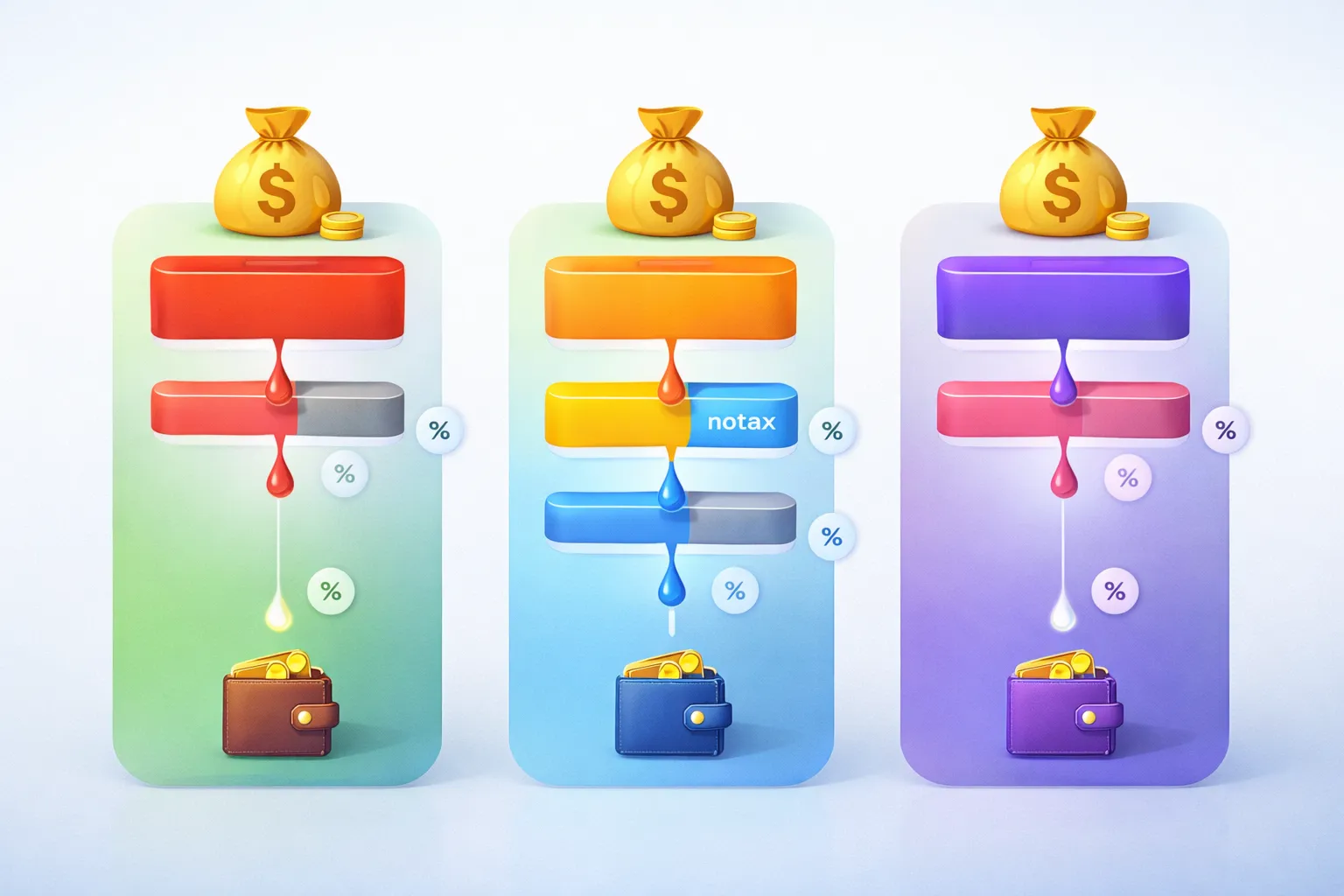
How Taxes Work for Each Structure
Let’s break down exactly how taxes work for each structure.
LLC Taxes
What you pay:
- Self-employment tax (15.3% on all profit)
- 12.4% Social Security (on first $184,500 in 2026)
- 2.9% Medicare (no limit)
- Additional 0.9% Medicare on income over $200,000/$250,000
- Federal income tax (10% – 37% depending on your total taxable income)
- State income tax (varies by state)
Example:
You make $100,000 profit in your LLC.
- Self-employment tax: ~$14,130 (after deducting half for income tax purposes)
- Federal income tax: Depends on your bracket, but let’s say 24% = $24,000
- Total federal tax: ~$38,130
That’s approximately 38% gone to taxes.
S-Corp Taxes
What you pay:
- Payroll tax on salary only (15.3% — half paid by company, half by you)
- Federal income tax on all income (salary + distributions)
- State income tax
The key: distributions avoid the 15.3% self-employment/payroll tax.
Example:
Same $100,000 profit, but now you’re an S-Corp.
You pay yourself a $60,000 salary and take $40,000 in distributions.
- Payroll tax on salary: $9,180 (15.3% of $60,000)
- Federal income tax on full $100,000: ~$24,000 (same 24% bracket)
- Total federal tax: ~$33,180
Compared to the LLC: you saved about $4,950.
Important notes:
- This is a simplified example
- Your actual savings depend on your specific salary/distribution split
- You also have additional costs (payroll service, bookkeeping, tax prep)
- Savings increase with higher profits
C-Corp Taxes
What the company pays:
- Corporate income tax (flat 21% federal)
- State corporate tax (varies — 0% in Nevada/Wyoming to 11.5% in New Jersey; average around 6.5%)
What you pay personally:
- Salary (taxed as regular income + payroll taxes)
- Dividends (taxed at 0%, 15%, or 20% qualified dividend rates, plus 3.8% Net Investment Income Tax for high earners)
Example:
Same $100,000 profit.
- Corporate tax (21%): $21,000
- Remaining: $79,000
- You distribute as dividend
- Dividend tax (15% + 3.8%): ~$14,880
- You keep: ~$64,120
Total tax: ~$35,880 (35.9% effective rate)
This is higher than both LLC and S-Corp in this scenario.
When C-Corp wins:
If you’re reinvesting all profits and not taking dividends, you only pay the 21% corporate rate initially. For someone in a high personal tax bracket (37%), the corporate rate is much lower.
And if you qualify for QSBS when you eventually sell, you could pay $0 on up to $15 million in gains (under rules enhanced by the One Big Beautiful Bill Act of 2025).
When Does an S-Corp Actually Save Tax?
This is the question everyone wants answered with a specific number.
The truth is: it depends on your profit level.
Here’s what research and tax professionals generally find:
Below ~$40,000-50,000 profit:
S-Corp savings usually don’t justify the extra costs (payroll setup, bookkeeping, tax preparation). Stick with an LLC.
Between $60,000-$80,000 profit:
This is typically where S-Corp starts making sense. The self-employment tax savings begin to outweigh the additional compliance costs.
Above $100,000 profit:
S-Corp savings become more significant. According to tax professionals, businesses at this level can save anywhere from $5,000 to $15,000+ annually in self-employment taxes.
The payroll cost tradeoff:
Remember, becoming an S-Corp means:
- Running payroll every pay period (cost: $500-$1,500/year for payroll service)
- More complex bookkeeping (cost: $1,000-$3,000/year)
- More complex tax return (Form 1120-S instead of Schedule C; cost: $800-$2,500/year for CPA)
Total added cost: roughly $2,000-$4,500 per year.
So if you’re only saving $3,000 in self-employment tax, is it worth the headache? Maybe not.
Qualified Business Income (QBI) Deduction:
Both LLCs and S-Corps can benefit from the Section 199A QBI deduction, which allows you to deduct up to 20% of qualified business income.
This deduction was made permanent under the One Big Beautiful Bill Act signed July 4, 2025. Previously it was set to expire after 2025.
For 2026:
- Full deduction available for single filers with taxable income below $191,950 and married filing jointly below $383,900
- Phaseout begins above these thresholds
- W-2 wage and qualified property limitations may apply
S-Corps can actually benefit more from QBI because of how the W-2 salary component interacts with the limitations.
California LLC vs S-Corp
State taxes can dramatically change the math.
California LLCs:
California charges an $800 annual franchise tax plus a gross receipts fee:
- $0 on less than $250,000 gross receipts
- $900 on $250,000 – $499,999
- $2,500 on $500,000 – $999,999
- $6,000 on $1,000,000 – $4,999,999
- $11,790 on $5,000,000+
This fee is based on gross receipts, not profit — so even if you lose money, you might owe the fee.
California S-Corps:
S-Corps pay the same $800 minimum franchise tax, but instead of the gross receipts fee, they pay 1.5% tax on net income.
For profitable businesses, S-Corp treatment can save money in California. For example, if your gross receipts are $600,000 but your net profit is only $80,000:
- LLC fee: $800 + $2,500 = $3,300
- S-Corp fee: $800 + 1.5% of $80,000 = $800 + $1,200 = $2,000
Savings: $1,300
Florida LLC vs S-Corp
Florida has no state income tax, which simplifies the decision.
Florida LLCs:
- No state income tax on individuals
- Self-employment tax still applies federally
Florida S-Corps:
- Still no state income tax
- Federal self-employment tax savings still apply
The decision in Florida is purely based on federal tax considerations. If your profit level justifies S-Corp election for federal tax purposes, the lack of state income tax doesn’t change that calculation.
Do S-Corps Get 1099s?
This is one of the most common questions I hear.
General rule: No.
S-Corps (and C-Corps) are generally exempt from receiving 1099-NEC or 1099-MISC forms because the IRS considers corporations to already have strict reporting requirements.
However, there are important exceptions:
- Payments to attorneys — Even if the law firm is an S-Corp or C-Corp, you must issue a 1099 for legal fees of $600 or more
- Medical and healthcare payments — Payments of $600+ to medical providers must be reported even if they’re incorporated
- Substitute payments — Certain financial transactions
What about LLCs?
- Single-member LLC (taxed as sole proprietor): Yes, gets 1099
- Multi-member LLC (taxed as partnership): Yes, gets 1099
- LLC taxed as S-Corp: No, exempt (with the attorney/medical exceptions)
- LLC taxed as C-Corp: No, exempt (with the attorney/medical exceptions)
Do S-Corps and C-Corps need to issue 1099s?
Yes. Just because you don’t receive them doesn’t mean you don’t issue them.
If your S-Corp or C-Corp pays $600 or more to:
- Sole proprietors
- Partnerships
- LLCs (not taxed as corporations)
- Independent contractors
You must issue them a 1099-NEC by January 31.
Pro tip: Always collect Form W-9 from vendors before paying them. The W-9 tells you their tax classification and whether you need to issue a 1099.
How to Convert LLC to S-Corp
Converting is actually simple — you’re not changing your legal structure, just your tax treatment.
The process:
- Verify eligibility:
- Must have fewer than 100 owners
- All owners must be U.S. citizens or residents (no foreign owners)
- Can only have one class of stock/membership interests
- Can’t be certain types of businesses (financial institutions, insurance companies)
- File Form 2553 with the IRS
- Get all members to sign the form consenting to the election
- Submit by the deadline:
- For 2026 tax year: March 17, 2026 (March 15 falls on Sunday)
- Or any time during 2025 for 2026 election
Tax consequences:
Generally, there are no tax consequences if you file timely and your LLC qualifies.
However:
- You must start running payroll immediately
- Your LLC will file Form 1120-S instead of Schedule C or Form 1065
- You’ll receive Schedule K-1s instead of reporting directly on Schedule C
State requirements:
Some states require separate state-level S-Corp elections. Check your state’s requirements — federal election doesn’t always cover state treatment.
C-Corp to S-Corp Conversion
This is more complex than LLC to S-Corp.
The process:
File Form 2553 by the deadline, just like an LLC.
Tax consequences:
The big issue is built-in gains tax.
If your C-Corp has appreciated assets (assets worth more than what you paid for them), and you sell those assets within 5 years of converting to S-Corp, you’ll pay a 21% built-in gains tax on the appreciation.
Example:
Your C-Corp bought equipment for $50,000. It’s now worth $100,000. You convert to S-Corp. Three years later, you sell it for $100,000.
Built-in gain: $50,000
Built-in gains tax: $50,000 × 21% = $10,500
This is on top of the regular tax you’d pay on the sale.
Accumulated earnings and profits (E&P):
If your C-Corp has accumulated earnings from its C-Corp years, distributions from those earnings are taxed as dividends (not S-Corp distributions).
This creates complexity that most small businesses don’t want to deal with.
Bottom line: Converting from C-Corp to S-Corp is doable but has more tax complications than LLC to S-Corp. Consult a CPA before making this move.
Ownership Restrictions Explained
Each structure has different rules about who can own it.
Can a Trust Own an S-Corp?
Yes, but only certain types of trusts:
Eligible trusts include:
- Grantor trusts (during grantor’s lifetime)
- Testamentary trusts (for 2 years after death)
- Qualified Subchapter S Trusts (QSSTs)
- Electing Small Business Trusts (ESBTs)
Regular irrevocable trusts generally can’t be S-Corp shareholders.
Can an S-Corp Own an LLC?
Yes. An S-Corp can own a single-member LLC. The LLC is treated as a disregarded entity (ignored for tax purposes).
This structure is sometimes used for liability separation — for example, having an S-Corp operating company own an LLC that holds real estate.
Can a C-Corp Own an S-Corp?
No. S-Corps cannot have corporate shareholders. Only individuals, estates, and certain trusts can own S-Corp stock.
This is one reason venture-backed companies use C-Corps — it allows for complex ownership structures including corporate investors.
Can an S-Corp Be a Partner in a Partnership?
Yes. An S-Corp can be a partner in a partnership (LLC taxed as partnership). This doesn’t violate S-Corp ownership rules.
S-Corp Advantages
Let’s recap the benefits:
1. Self-employment tax savings
The ability to split income between salary and distributions can save thousands in payroll taxes annually for profitable businesses.
2. QBI deduction eligibility
S-Corps qualify for the 20% qualified business income deduction (now permanent under the One Big Beautiful Bill Act of 2025).
3. Retirement plan contributions
S-Corp owners can contribute to retirement accounts:
- Solo 401(k): Up to $23,500 in 2026 (employee contribution) plus up to 25% of W-2 compensation (employer contribution)
- SEP IRA: Up to 25% of W-2 compensation
- Combined maximum for 2026: $70,000 (plus $7,500 catch-up if 50+)
These contributions reduce taxable income while building retirement savings.
4. Health insurance deduction
S-Corp owners who own more than 2% can deduct health insurance premiums, but it’s reported differently than regular employees. The premiums are deducted on your personal tax return (Form 1040), not as a pre-tax payroll deduction.
5. Credibility
Some clients and partners prefer working with corporations over sole proprietors. Having a formal structure can enhance business credibility.
S-Corp Disadvantages
It’s not all upside. Here are the downsides:
1. Payroll requirement
You must run payroll. This means:
- Quarterly payroll tax deposits (Form 941)
- Annual W-2s and W-3s
- State payroll tax filings
- Payroll service fees ($40-$100/month)
2. Bookkeeping complexity
S-Corp accounting is more involved than LLC accounting. You need to track:
- Payroll separately from distributions
- Shareholder basis
- Reasonable compensation analysis
This typically means higher bookkeeping costs.
3. Reasonable salary compliance
The IRS scrutinizes S-Corps with low or no salary. You must pay yourself market-rate compensation, and you need to be able to defend your salary if audited.
If you pay yourself too little, the IRS can reclassify distributions as wages, adding payroll taxes plus penalties and interest.
4. Tax return complexity
Form 1120-S is more complex than Schedule C. Expect to pay $800-$2,500 for professional preparation (vs $300-$800 for a simple Schedule C).
5. Ownership restrictions
Maximum 100 shareholders, must be individuals or qualifying trusts, no foreign owners, one class of stock only.
These restrictions don’t matter for small businesses but can limit growth options.
6. State-level complications
Some states don’t recognize S-Corp status or tax S-Corps differently. Others require separate state elections. This adds compliance burden.
C-Corp Pros and Cons
C-Corp Advantages:
- Venture capital compatible — VCs require C-Corps for preferred stock and complex cap tables
- QSBS tax benefits — Under the One Big Beautiful Bill Act of 2025, qualifying C-Corp stock can exclude up to $15 million in capital gains when sold (increased from $10 million), with tiered holding periods:
- 50% exclusion after 3 years
- 75% exclusion after 4 years
- 100% exclusion after 5 years
- Unlimited shareholders — No restrictions on number or type of shareholders
- Foreign ownership allowed — Non-resident aliens can own stock
- Certain fringe benefits — Some employee benefits are fully deductible for C-Corps but not for S-Corps
C-Corp Disadvantages:
- Double taxation — Profits taxed at corporate level (21%) then again as dividends (0-23.8%)
- More expensive to operate — Higher accounting costs, more paperwork, stricter compliance requirements
- Losses trapped — Unlike pass-through entities, you can’t deduct business losses on your personal return
- Dividend treatment — Distributions are dividends (taxed), not return of capital
- Higher audit scrutiny — C-Corps face more IRS scrutiny than LLCs or S-Corps
How to Pay Yourself as an S-Corp Owner
This is where many S-Corp owners get confused.
Two types of payments:
- W-2 salary — Regular payroll wages
- Distributions — Owner draws from profits
How much salary should you pay?
Your salary must be “reasonable” based on what you’d pay an unrelated employee to do your job.
Research market rates by:
- Checking salary surveys for your position and industry
- Looking at comparable roles on job sites like Indeed, Glassdoor
- Consulting with your CPA who has industry data
Common salary approach:
Many S-Corp owners use a strategy where salary represents a meaningful portion of their total compensation — often in the 30-50% range — but this isn’t a rule, just a pattern.
The key is market rate. If comparable positions in your field pay $100,000, you can’t justify a $30,000 salary just to minimize payroll taxes.
How to take distributions:
After paying yourself salary, remaining profits can be distributed.
Process:
- Ensure you have positive shareholder basis (essentially, your investment plus cumulative profits minus losses and distributions)
- Write a check from the business account to yourself
- Record as a shareholder distribution (not an expense)
- Track it in your accounting system
Distributions should be taken periodically (monthly or quarterly) rather than in one lump sum at year-end.
Retirement plan contributions:
S-Corp owners can set up:
- Solo 401(k)
- SEP IRA
- SIMPLE IRA (if you have employees)
These contributions are based on your W-2 salary, not total profit. Higher salary = higher potential retirement contributions.
Cost to Set Up Each Structure
Let’s talk about real costs.
LLC Setup Costs
Initial:
- State filing fee: $35-$500 (average $130)
- Operating agreement: $0-$500
- EIN: $0 (free from IRS)
Ongoing annual:
- State annual report/fee: $0-$800 (California is the most expensive at $800 minimum)
- Business license: Varies by location
- Bookkeeping: $500-$2,000/year (DIY to professional)
- Tax preparation: $300-$800 for Schedule C
Total first year: $500-$1,500
Ongoing annual: $800-$3,000
S-Corp Additional Costs (Beyond LLC)
One-time:
- Form 2553 filing: $0 (it’s free)
- Initial payroll setup: $100-$300
Ongoing annual:
- Payroll service: $500-$1,500/year
- Additional bookkeeping: $1,000-$2,500/year
- Tax preparation (Form 1120-S): $800-$2,500/year
- State S-Corp fees: Varies
Total added cost over LLC: $2,300-$6,500/year
This is why S-Corp needs to save you more than this amount to be worth it.
C-Corp Setup Costs
Initial:
- State incorporation fee: $100-$500
- Bylaws and corporate records: $300-$1,000
- Stock issuance: $100-$500
- EIN: $0
Ongoing annual:
- State annual report: $50-$800
- Corporate compliance: $500-$2,000
- Bookkeeping: $2,000-$5,000/year
- Tax preparation (Form 1120): $1,500-$5,000+
- Board meetings and minutes: $500-$2,000
Total first year: $2,500-$7,000
Ongoing annual: $4,500-$14,000+
C-Corps are significantly more expensive to operate than LLCs or S-Corps.
Which Structure Is Right for You?
Let me give you three profiles:

Profile 1: Beginner Under $50k Profit
Best structure: LLC
If you’re just starting out or your business makes less than $40,000-50,000 in profit, stick with a simple LLC.
Why?
- S-Corp costs ($2,300-$6,500/year) likely exceed tax savings
- Simpler accounting and tax filing
- Easier to manage on your own
- You can always convert to S-Corp later when profitable
Action: Form an LLC in your state, get an EIN, open a business bank account, and focus on growing revenue.
Profile 2: Growing Business $75k-$200k Profit
Best structure: LLC taxed as S-Corp
This is the sweet spot for S-Corp election.
Why?
- Self-employment tax savings ($5,000-$15,000/year) justify the added complexity
- You can afford professional help (CPA, bookkeeper)
- QBI deduction is enhanced by W-2 wages
- Still simple enough to manage
Action: If you’re currently an LLC making this level of profit, run the numbers with a CPA to see if S-Corp makes sense. File Form 2553 by March 17, 2026 for 2026 tax year.
Profile 3: Venture-Backed Startup
Best structure: C-Corp
If you’re raising venture capital or plan to in the future, start as a C-Corp.
Why?
- VCs require C-Corp structure
- QSBS benefits can save millions on exit
- Allows for complex cap tables and preferred stock
- Foreign investors are allowed
But remember: If you’re just planning to run a profitable small business and keep the cash flow, C-Corp’s double taxation will cost you. Only choose C-Corp if you’re genuinely on a venture path.
Action: Incorporate in Delaware (if raising VC) or your home state, work with a startup attorney for proper setup, and ensure you qualify for QSBS from day one.

7 Mistakes Founders Make When Choosing Structure
These are mistakes I’ve seen other founders make, read about in forums, and some I’ve almost made myself:
1. Electing S-Corp too early
Many founders elect S-Corp status before they’re profitable enough to justify it. The added costs eat into their limited cash flow with no tax benefit.
Wait until: Your profit consistently exceeds $60,000-80,000.
2. Choosing C-Corp for the wrong reasons
Some founders choose C-Corp thinking it sounds more “professional” or impressive, not understanding the tax consequences.
Only choose C-Corp if: You’re raising VC or pursuing QSBS strategy. Otherwise, pass-through structures are more tax-efficient.
3. Paying themselves too little as S-Corp
Trying to game the system by paying $20,000 salary on $150,000 profit. This is audit bait.
Pay market rate: Research comparable salaries and document your analysis.
4. Not running payroll correctly
Treating S-Corp distributions like salary or not running payroll at all.
Do it right: Set up proper payroll with a service like Gusto, ADP, or QuickBooks Payroll from day one.
5. Mixing business and personal money
Using the business account like a personal account destroys your liability protection.
Separate everything: Business expenses on business account, personal expenses on personal account. Take formal distributions.
6. Forgetting state requirements
Assuming federal S-Corp election automatically applies at state level.
Check your state: Some states require separate elections or don’t recognize S-Corp status at all.
7. Not consulting a CPA before switching
Making major tax elections based on something you read online (including this article) without professional analysis of your specific situation.
Get professional help: A good CPA can run the numbers for your actual situation and save you from expensive mistakes.
Quick Comparison Table
| Feature | LLC (Default) | S-Corp | C-Corp |
|---|---|---|---|
| Tax Type | Pass-through | Pass-through | Separate entity |
| Self-Employment Tax | Yes (15.3% on all profit) | Only on salary | N/A |
| Income Taxed | Once (personal return) | Once (personal return) | Twice (corporate + personal) |
| Best For | Starting out, under $50k profit | $60k-$200k+ profit | Raising VC, QSBS strategy |
| Complexity | Simple | Moderate | High |
| Annual Cost | $800-$3,000 | $3,000-$9,000 | $5,000-$15,000+ |
| Investor Friendly | No | Somewhat | Yes (VCs prefer) |
| Owner Limit | Unlimited | 100 max | Unlimited |
| Foreign Owners | Yes | No | Yes |
| Best Tax Rate | Personal rate | Personal rate (with SE savings) | 21% + dividend rate |
| QBI Deduction | Yes | Yes | No |
| Setup Difficulty | Easy | Moderate | Complex |
Frequently Asked Questions
How are S-Corp distributions taxed?
S-Corp distributions are not taxed directly — but they’re also not additional income.
Here’s how it works: Your S-Corp’s profit flows through to your personal tax return via Schedule K-1. You pay tax on all the profit whether you take distributions or not.
Distributions are simply a way to access that after-tax money. They don’t add to your taxable income, and they’re not subject to payroll taxes.
However, distributions reduce your “basis” in the S-Corp. If you take more in distributions than your basis, the excess is taxed as capital gains.
Does an S-Corp get a 1099?
Generally, no. S-Corps are exempt from receiving 1099-NEC or 1099-MISC forms for services provided.
Exceptions:
- Attorney fees: Even incorporated attorneys receive 1099s
- Medical payments: Healthcare providers receive 1099s regardless of entity type
- Gross proceeds to attorneys: Legal settlements must be reported
If you pay an S-Corp for other services (consulting, IT, marketing), you don’t need to issue a 1099.
Can I convert my LLC to S-Corp later?
Yes. This is very common.
You file Form 2553 with the IRS by March 15 (or March 17, 2026 since the 15th falls on Sunday) to elect S-Corp treatment for that tax year.
There’s generally no tax consequence for the conversion itself — you’re just changing how the IRS taxes your business.
The challenge is ensuring you have payroll set up and running from the election date forward.
What is the S-Corp 60/40 rule?
The “60/40 rule” is a myth. It suggests paying yourself 60% salary and 40% distributions.
This has no basis in IRS regulations. The IRS requires “reasonable compensation” based on market rates for your role, industry, and location — not a percentage formula.
Some businesses end up near 60/40, but that’s coincidence, not a rule. Others might be 70/30 or 50/50. It depends on what the market pays for your position.
Always base your salary on what you’d pay an unrelated employee to do your job.
Is C-Corp better for startups?
If you’re raising venture capital: Yes.
VCs require C-Corp structure because:
- They need preferred stock (S-Corps can only have one class)
- They’re institutional investors (S-Corps can’t have corporate shareholders)
- They need complex liquidation preferences and rights
If you’re building a bootstrapped, profitable business: No.
The double taxation of C-Corps makes them inefficient for small businesses distributing profits to owners.
If you’re pursuing QSBS: C-Corp can make sense even without VC, as the potential to exclude $15 million in capital gains tax-free (under enhanced 2025 rules) is powerful for high-growth companies planning an exit.
Do C-Corps get 1099s?
Generally, no. C-Corps are exempt from most 1099 requirements.
Exceptions (same as S-Corps):
- Attorney fees ($600+)
- Medical and healthcare payments ($600+)
For all other services — consulting, marketing, IT, design, etc. — you don’t issue 1099s to C-Corps.

Conclusion
Choosing between LLC, S-Corp, and C-Corp isn’t about finding the objectively “best” structure. It’s about finding the right structure for your profit level, growth plans, and goals.
Here’s my practical framework:
Start with an LLC if you’re just getting going or making under $50,000 in profit. It’s simple, flexible, and you can always convert later.
Consider S-Corp when your profit consistently exceeds $60,000-80,000 and you’re willing to handle the added complexity. The self-employment tax savings justify the cost and effort at this level.
Choose C-Corp only if you’re raising venture capital, pursuing QSBS strategy, or need to reinvest all profits for growth while you’re in a high personal tax bracket.
Whatever you choose, make sure you:
- Understand the tax implications
- Can handle the compliance requirements
- Have the profit level to justify the structure
- Work with a qualified CPA or tax professional
Your business structure is important, but it’s not permanent. You can convert from LLC to S-Corp when it makes sense. You can even go from C-Corp to S-Corp (though it’s more complex).
The key is making an informed decision based on your actual situation — not what some blog post or guru says is “the best.”
Next steps:
- Calculate your actual annual profit (revenue minus all expenses)
- If under $50k: Stay LLC or form as LLC
- If $60k-$200k: Run S-Corp analysis with a CPA
- If raising VC or pursuing QSBS: Start as C-Corp with proper legal setup
- Consult with a CPA who can analyze your specific numbers
At BizFromZero, I’m learning alongside you about what actually works when building a business from zero. The right structure isn’t about hype or what sounds impressive — it’s about what actually makes sense for your business today and where you’re heading.

1 thought on “LLC vs S-Corp vs C-Corp: Which Saves More Tax? (2026)”