

If you’re reading this from outside the United States and wondering whether you can legally start a business in the US, I have good news for you.
You can.
You don’t need to be a US citizen. You don’t need a green card. You don’t need a Social Security Number. And in most cases, you don’t even need to visit the United States.
When I started learning about how non-residents could form US businesses, I was surprised by how accessible the process actually is. The US system is designed to welcome foreign founders and entrepreneurs — as long as you follow the right steps and understand the requirements.
This guide will walk you through everything: choosing a business structure, filing formation documents, getting an EIN, opening a bank account, and understanding your tax obligations. I’ll also share realistic costs, timelines, and common mistakes to avoid.
Important: This content is for educational purposes only and does not constitute legal, tax, or immigration advice. Consult a qualified professional before making decisions.
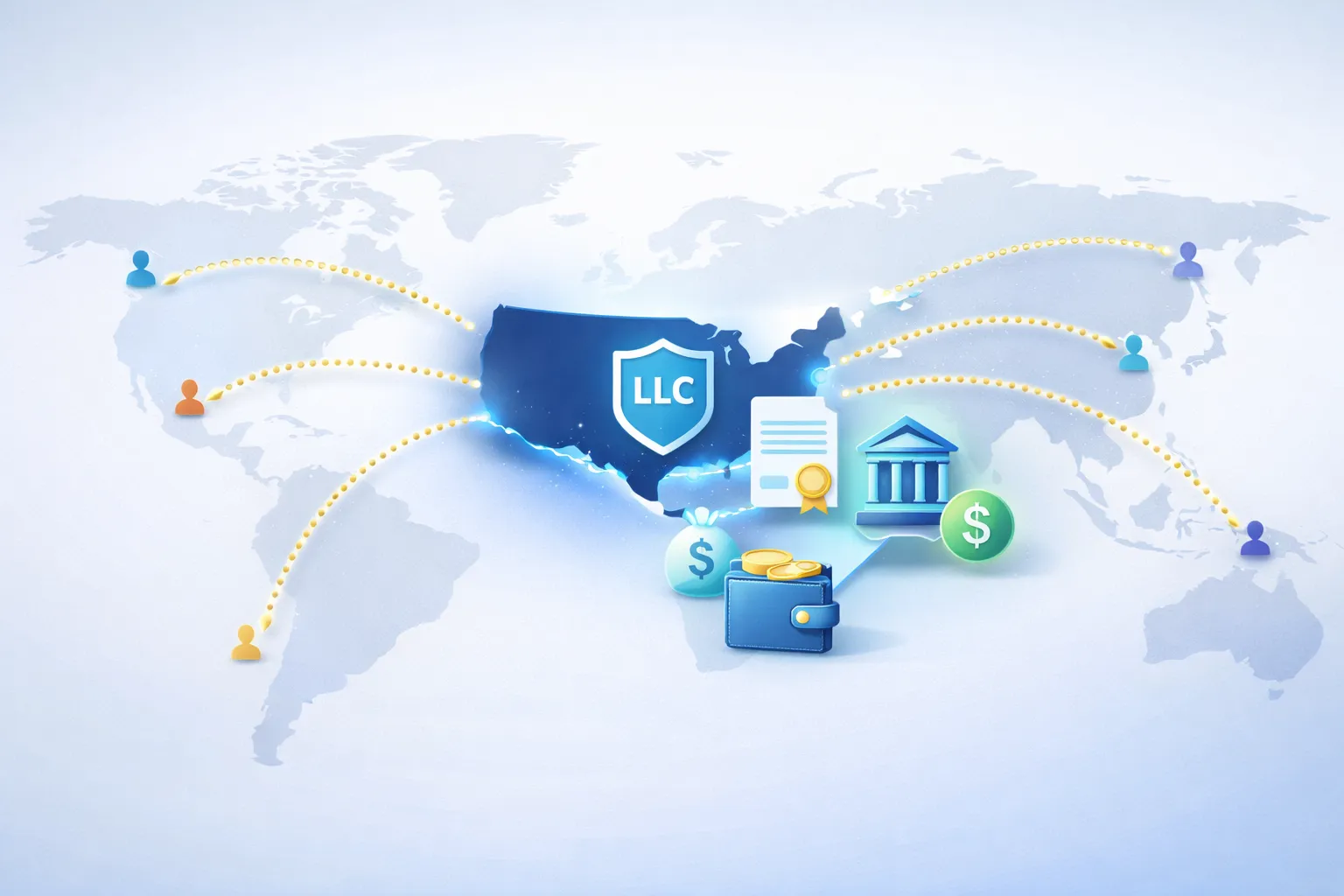
Is It Legal for Non-Residents to Own a US Company?
Yes. Absolutely.
There are no citizenship or residency requirements to own a US business. Non-residents can legally:
- Form an LLC (Limited Liability Company)
- Incorporate a C-Corp
- Own 100% of the company
- Operate the business entirely from outside the US
What’s important to understand:
Owning a US company is completely different from working in the US.
- Owning a company = Legal for anyone, anywhere
- Working physically in the US = Requires appropriate visa or work authorization
As a non-resident owner, you can:
- Manage your business remotely
- Hire US employees or contractors
- Sell products or services globally
- Open a US bank account
- Apply for business credit
You cannot:
- Work from within the US without proper authorization
- Live in the US based solely on owning a business (there’s no “business owner visa”)
- Ignore US tax obligations on US-sourced income
LLC vs C-Corp for Non-US Founders
The first decision you’ll need to make is your business structure. For non-residents, the two main options are LLC and C-Corp.
LLC (Limited Liability Company)
An LLC is the most common choice for non-resident founders running service businesses, e-commerce stores, or small operations.
How it works:
- Protects your personal assets from business debts
- Flexible tax treatment (can be taxed as a sole proprietor, partnership, S-Corp, or C-Corp)
- Simple to form and maintain
- Lower annual compliance requirements
Tax treatment for non-residents: By default, a single-member LLC owned by a non-resident is treated as a “disregarded entity” for US tax purposes. This means:
- If you earn US-sourced income (customers in the US), you typically file Form 1040-NR and may owe US tax
- If you earn foreign-sourced income (customers outside the US), you generally don’t file US income tax returns (but you do file Form 5472 for informational purposes)
Best for:
- Freelancers and consultants
- E-commerce sellers (Amazon, Shopify)
- Digital service providers
- SaaS businesses serving non-US markets
- Anyone not raising venture capital
C-Corp (C Corporation)
A C-Corp is a separate legal entity that pays its own taxes.
How it works:
- The corporation pays federal tax on profits (21% flat rate)
- When you take money out as dividends, you pay personal tax on those dividends
- This creates “double taxation”
Why would a non-resident choose C-Corp?
- Raising venture capital: VCs strongly prefer (often require) C-Corps
- QSBS benefits: Qualified Small Business Stock can allow you to exclude up to $15 million in capital gains when you sell (under rules enhanced by the One Big Beautiful Bill Act of 2025)
- Complex ownership: C-Corps allow multiple classes of stock, which LLCs don’t
Tax treatment for non-residents:
- The corporation pays 21% federal corporate tax on profits
- If you take dividends, the US typically withholds 30% tax (unless reduced by a tax treaty between the US and your country)
Best for:
- Startups raising venture capital
- Founders planning a future acquisition or IPO
- Businesses with complex ownership structures
My recommendation
For most non-resident founders just getting started: form an LLC.
It’s simpler, more flexible, and costs less to maintain. You can always convert to a C-Corp later if you decide to raise venture capital.
Delaware vs Wyoming vs Florida: Best States for Non-US Founders
When forming a US company as a non-resident with no physical presence, you need to choose a state. The three most popular choices are Delaware, Wyoming, and Florida.

Delaware
Filing fee: $90
Annual fee: $300 (annual franchise tax)
Processing time: 1-5 days
Why Delaware is popular:
- Established legal precedents for business law
- Preferred by venture capital firms
- Business-friendly court system (Chancery Court)
- Strong privacy protections
Downsides:
- Higher annual costs ($300/year ongoing)
- Requires a registered agent (adds $50-$125/year)
Choose Delaware if: You’re raising venture capital or building a startup that will seek funding.
Wyoming
Filing fee: $100
Annual fee: $60
Processing time: 1-3 days
Why Wyoming is popular:
- Lowest annual costs
- Strong privacy protections (beneficial owners not publicly listed)
- No state corporate or personal income tax
- Simple compliance requirements
Downsides:
- Less established for venture-backed companies
- Smaller legal precedent base
Choose Wyoming if: You’re running a bootstrapped business and want to minimize ongoing costs.
Florida
Filing fee: $125
Annual fee: $138.75
Processing time: 2-5 days
Why Florida is popular:
- No state personal income tax
- Fast processing times
- Growing tech and business ecosystem
- Good balance between cost and credibility
Downsides:
- Mid-range fees
- Requires registered agent
Choose Florida if: You want a balance between cost and credibility, or plan to eventually have a physical presence in Florida.
The honest truth
For non-residents with no physical US presence, Wyoming offers the best combination of low cost and strong privacy. Delaware is better if you’re pursuing venture capital. Florida is a good middle ground.
There’s no universally “best” state — it depends on your business goals and budget.
Step-by-Step Process to Form a US Business as a Non-Resident
Let me walk you through the exact steps.

Step 1 – Choose a Business Name
Your business name must be unique in the state where you’re forming.
How to check availability:
- Go to your chosen state’s Secretary of State website
- Search the business name database
- If available, proceed with filing
Naming rules:
- Must include “LLC” or “Limited Liability Company” (for LLCs)
- Can’t be confusingly similar to existing businesses
- Can’t include restricted words without approval
Tip: Have 2-3 backup names ready in case your first choice is taken.
Step 2 – Appoint a Registered Agent
Every US business needs a registered agent — a person or service with a physical address in your formation state who can receive legal documents on behalf of your company.
As a non-resident, you have two options:
Option 1: Hire a registered agent service
- Cost: $50-$150/year
- Provides a US address for legal correspondence
- Forwards documents to you electronically or by mail
- Maintains your privacy (your personal address isn’t public)
Option 2: Use a formation service that includes registered agent
- Many LLC formation services include the first year free
- Annual renewal typically $100-$125/year
Popular registered agent services:
You cannot:
- Be your own registered agent (you must have a physical US address during business hours)
- Use a P.O. box
Step 3 – File Formation Documents
This is the official step that creates your business entity.
For LLC: File “Articles of Organization” (also called “Certificate of Formation” in some states)
What you’ll provide:
- LLC name
- Registered agent name and address
- Principal business address (can be your registered agent’s address)
- Member names and addresses (your name and home country address)
- Management structure (member-managed or manager-managed)
Where to file: Go to your state’s Secretary of State website and file online. Most states allow online filing.
Costs:
- State filing fee: $50-$125 (depending on state)
- Processing time: 1-10 days (varies by state)
- Expedited processing: Available in most states for an extra $25-$100
For C-Corp: File “Articles of Incorporation”
Similar information required, plus:
- Number of authorized shares
- Par value (if applicable)
- Incorporator information
Step 4 – Get an EIN from the IRS
An EIN (Employer Identification Number) is your business’s tax identification number. You need it to open a bank account, hire employees, and file taxes.
Here’s the challenge for non-residents: You cannot apply for an EIN online without a US Social Security Number or Individual Taxpayer Identification Number (ITIN).
How non-residents get an EIN:
Method 1: Fax or Mail Form SS-4
- Download Form SS-4 from the IRS website (irs.gov)
- Fill it out completely:
- Line 7b (responsible party SSN/ITIN): Write “Foreign” or “N/A” if you don’t have an SSN or ITIN
- Provide all other business information accurately
- Fax to: (855) 641-6935 (for international applicants)
- Or mail to: Internal Revenue Service, Attn: EIN Operation, Cincinnati, OH 45999
Processing time:
- By fax: 5-15 business days (sometimes faster)
- By mail: 4-8 weeks
Method 2: Call the IRS
International applicants can call the IRS directly at +1 (267) 941-1099 (not toll-free) during business hours (6 AM – 11 PM Eastern Time, Monday-Friday).
Have your Form SS-4 information ready. They’ll issue your EIN over the phone if you qualify.
Method 3: Hire a service
Many formation services will obtain your EIN for you as part of their package. Cost typically: $50-$150 as an add-on service.
What you’ll receive:
- Your 9-digit EIN
- IRS Letter CP 575 (EIN confirmation letter)
Important: Keep this CP 575 letter. Banks require it to open an account.
Step 5 – Open a US Business Bank Account
Opening a US bank account as a non-resident has become more challenging in 2026, but it’s still possible with the right preparation.
Traditional banks (Chase, Bank of America, Wells Fargo):
- Usually require in-person visit to the US
- Strict documentation requirements
- Not practical for most non-residents
Fintech banks (Mercury, Wise, Relay, Airwallex):
- Allow fully remote account opening
- Designed for international founders
- Faster approval process
- No physical branch visits required
What you’ll need to open an account:
- EIN confirmation letter (CP 575) from the IRS
- Articles of Organization (formation documents)
- Government-issued ID (passport)
- Proof of address in your home country (bank statement, utility bill)
- Operating Agreement (sometimes required)
Current banking options for non-residents (2026):
Wise Business (Easiest approval)
- Not a traditional bank; it’s an Electronic Money Institution (EMI)
- Provides US bank details (account and routing numbers)
- Multi-currency support
- Cost: $31 one-time setup fee
- No FDIC insurance (funds held in segregated accounts with partner banks)
- Approval time: 24-48 hours typically
- Best for: International transactions, receiving payments from US clients
Relay (Recommended for FDIC protection)
- Fintech platform partnering with FDIC-insured banks
- Offers up to $3 million FDIC insurance through Thread Bank sweep program
- Multiple sub-accounts for organization
- Cost: Free checking account
- Approval time: 1-3 days
- Best for: US-focused operations, higher balances
Mercury (Startup-focused)
- Popular among tech startups
- Free domestic and international USD wires
- Integrations with Stripe, QuickBooks, etc.
- Cost: Free checking account
- 2025 update: Now requires physical US business address (not just registered agent address)
- Some non-residents report approval difficulties in 2025
- Best for: Startups with actual US operations or US-based team members
Airwallex
- Global payments platform
- Multi-currency accounts
- Good for international businesses
- Mixed reviews for non-resident approval in 2025
Application strategy:
Based on current experiences from non-resident founders:
- First application: Wise (highest approval rate, fastest)
- Second application: Relay (for FDIC protection and US-focused operations)
- Third application (optional): Mercury if you have demonstrable US operations
Timeline:
- Account approval: 1-3 days (once you submit documents)
- Total timeline from LLC formation to active bank account: 6-12 weeks (mostly waiting for EIN)
Step 6 – Understand Your US Tax Obligations
This is where things get complex. Tax obligations for non-residents depend on several factors:
Factor 1: Where your customers are
- US-sourced income: Customers in the US = may owe US tax
- Foreign-sourced income: Customers outside the US = generally no US income tax (but filing requirements exist)
Factor 2: What kind of income
- Effectively Connected Income (ECI): Active business income connected to a US trade or business
- Fixed, Determinable, Annual, Periodic (FDAP) income: Passive income like interest, dividends, royalties
Basic tax scenarios:
Scenario 1: Single-member LLC, selling services to non-US clients
- Generally no US income tax owed
- Must file: Form 5472 (informational return) + pro forma Form 1120 annually
- Deadline: April 15 (or October 15 with extension)
- Penalty for not filing: $25,000+ per year
Scenario 2: Single-member LLC, selling to US clients
- May owe US income tax on US-sourced income
- Must file: Form 1040-NR (nonresident alien tax return)
- Tax rate: Progressive (10%-37%) on ECI
- May also need to file estimated quarterly taxes
Scenario 3: Multi-member LLC (partnership)
- Must file: Form 1065 (partnership return)
- Each member receives Schedule K-1
- Members may also need to file Form 1040-NR
Scenario 4: C-Corp
- Corporation files Form 1120 and pays 21% corporate tax
- If you take dividends, 30% withholding (unless reduced by tax treaty)
State taxes:
- Wyoming, Florida: No state income tax
- Delaware: $400 minimum tax for C-Corps with no nexus; LLCs pay $300 annual fee
- Other states: Varies
Tax treaties:
If your country has a tax treaty with the US, you may qualify for reduced withholding rates or tax exemptions on certain types of income. Check the IRS website for your country’s specific treaty provisions.
Bottom line: US tax law is complex for non-residents. I strongly recommend working with a CPA or tax professional who specializes in non-resident taxation, especially if you’re earning US-sourced income.
Step 7 – Comply with BOI Reporting (2026 Update)
This is major news: As of February 22, 2026, US-formed companies are EXEMPT from Beneficial Ownership Information (BOI) reporting.
What changed:
Previously, the Corporate Transparency Act (CTA) required all US businesses to report beneficial ownership information to FinCEN (Financial Crimes Enforcement Network).
On February 22, 2026, FinCEN issued an interim final rule that:
- Exempts all US-formed companies (LLCs, corporations) from BOI reporting
- Exempts US persons from reporting requirements
- Only foreign companies registered to do business in the US must now file BOI reports
What this means for non-resident founders:
If you form an LLC or C-Corp in a US state (Delaware, Wyoming, Florida, etc.), you do NOT need to file BOI reports with FinCEN.
This is a huge simplification compared to previous years when BOI filing was required.
Exception:
If you form a company in a foreign country and then register it to do business in a US state as a “foreign entity,” you would still need to file BOI. But this is rare — most non-residents form directly in a US state.
Note: This is an interim rule. FinCEN is accepting public comments until February 22, 2026, and will finalize the rule later in 2026. However, the exemption is currently in effect.
Do Non-Residents Need an ITIN?
Short answer: Usually not.
An ITIN (Individual Taxpayer Identification Number) is a tax processing number issued by the IRS to individuals who need to file US tax returns but don’t have a Social Security Number.
When you DON’T need an ITIN:
- You’re just forming an LLC (EIN is sufficient)
- Your LLC earns only foreign-sourced income (customers outside the US)
- You’re not taking salary or distributions that require US personal tax filing
When you DO need an ITIN:
- You must file a US personal tax return (Form 1040-NR)
- You’re earning US-sourced income that requires personal tax filing
- You’re claiming tax treaty benefits on your personal return
- You’re a member of a multi-member LLC partnership that requires personal filing
How to apply for an ITIN (if needed):
File Form W-7 with the IRS, along with:
- Your tax return (or proof of exception)
- Original passport or certified copies of identity documents
- Can be filed with help of an IRS Acceptance Agent
Processing time: 7-11 weeks
Important distinction:
- EIN = Business tax ID (for your LLC or corporation)
- ITIN = Personal tax ID (for you as an individual)
You always need an EIN for your business. You only need an ITIN if you personally must file US tax returns.
Cost Breakdown: How Much Does It Really Cost?
Let’s talk real numbers.
Initial setup costs:
| Item | Cost Range |
|---|---|
| State filing fee (LLC) | $50 – $125 |
| Registered agent (first year) | $50 – $150 |
| EIN application | $0 (free from IRS) |
| Operating agreement | $0 – $100 (templates available) |
| Total initial cost | $100 – $375 |
Annual ongoing costs:
| Item | Cost Range |
|---|---|
| State annual report/fee | $60 – $300 (varies by state) |
| Registered agent renewal | $100 – $150 |
| Tax preparation (Form 5472) | $200 – $500 |
| Bank account fees | $0 – $50/month |
| Total annual cost | $560 – $2,100 |
Additional costs (optional):
- Formation service (if you use one): $200-$500
- Legal consultation: $200-$500/hour
- Accounting/bookkeeping: $100-$500/month
- Business licenses: Varies by industry and location
Realistic first-year budget:
If you do everything yourself and choose Wyoming:
- Minimum: ~$210 (filing + registered agent + annual renewal)
- Realistic: $500-$800 (including professional tax prep)
If you use a formation service and hire help:
- Comfortable budget: $1,000-$1,500 first year
Ongoing years:
- Minimum: $360-$460/year (Wyoming or Florida with self-filed taxes)
- Realistic: $800-$1,500/year (with professional tax prep)
Common Mistakes Non-US Founders Make
From researching other founders’ experiences, here are the mistakes I’ve learned about:
1. Choosing Delaware blindly
Many non-residents form in Delaware because they’ve heard it’s “the best,” without understanding that Delaware has $300/year franchise tax. For most bootstrapped businesses, Wyoming’s $60/year is more practical.
Choose Delaware only if: You’re raising venture capital or need specific Delaware legal precedents.
2. Ignoring tax treaties
If your country has a tax treaty with the US, you may qualify for reduced withholding rates on dividends, interest, or royalties. Not claiming these benefits means you overpay tax.
Check: IRS Publication 901 for your country’s treaty provisions.
3. Not understanding US-sourced vs foreign-sourced income
This is critical for taxes. Selling to US customers generally creates US-sourced income. Selling to customers outside the US generally creates foreign-sourced income. The distinction dramatically affects your US tax obligations.
4. Forgetting annual reports
Every state requires an annual report or statement of information. Missing this can result in your LLC being dissolved or falling out of good standing.
Set a reminder for your state’s deadline.
5. Mixing personal and business finances
Opening a business bank account is just the start. You must actually use it for all business transactions. Mixing personal and business money can destroy your liability protection.
6. Applying for EIN before LLC is formed
The IRS requires your LLC to be officially formed before they’ll issue an EIN. If you apply too early, your application will be rejected.
Wait until you receive your formation approval from the state.
7. Not having a physical US address for banking
As of 2026, Mercury and some other banks no longer accept registered agent addresses as your business operating address. You need a physical address where your business operates.
Options:
- Virtual office with a physical street address (not a P.O. box)
- Address of a US-based business partner or employee
- Co-working space membership
8. Ignoring Form 5472 filing requirements
Even if you owe $0 in US tax, single-member LLCs owned by non-residents must file Form 5472 annually. The penalty for not filing is $25,000+ per year.
Don’t skip this even if you have no US income.
Real Example: Non-Resident Forming a Wyoming LLC
Let me walk through a realistic scenario:
Profile:
- Rohan, a digital marketing consultant from India
- Wants to work with US clients and accept USD payments
- No plans to raise venture capital
- Prefers lowest ongoing costs
Steps Rohan takes:
Month 1:
- Chooses Wyoming for formation (lowest annual costs)
- Selects business name: “Rohan Digital Marketing LLC”
- Hires Northwest Registered Agent ($125/year)
- Files Articles of Organization online with Wyoming Secretary of State ($100)
- Receives approval in 2 business days
Month 2: 6. Fills out IRS Form SS-4 7. Writes “Foreign” on line 7b (SSN/ITIN field) 8. Faxes Form SS-4 to IRS 9. Receives EIN by fax in 10 business days 10. Receives CP 575 letter by mail 3 weeks later
Month 3: 11. Applies for Wise Business account 12. Uploads: Passport, CP 575, Articles of Organization, proof of address (bank statement from India) 13. Approved in 24 hours 14. Receives US account and routing numbers 15. Can now accept USD payments from US clients
Costs:
- Wyoming filing: $100
- Registered agent: $125
- EIN: $0
- Wise account setup: $31
- Total: $256
Annual ongoing costs:
- Wyoming annual report: $60
- Registered agent renewal: $125
- Form 5472 tax prep: $300 (hired a CPA specializing in non-residents)
- Total annual: $485
Tax situation:
Rohan’s clients are in the US, so he earns US-sourced income. He must:
- File Form 1040-NR reporting his US income
- Pay US income tax on his net profit (after expenses)
- File Form 5472 + pro forma Form 1120
He works with a CPA familiar with non-resident taxation to ensure compliance.
Banking:
Rohan keeps most funds in Wise, transfers to his Indian bank account monthly. He maintains a small balance in Wise for USD transactions and payment processing fees.
Action Checklist for Non-US Residents
Here’s your step-by-step checklist:
☐ Decide on business structure (LLC vs C-Corp)
☐ Choose formation state (Delaware, Wyoming, or Florida)
☐ Check business name availability on state website
☐ Hire registered agent service
☐ Gather documents:
- Passport copy
- Proof of address in home country
☐ File Articles of Organization with state
☐ Wait for approval (1-10 days depending on state)
☐ Apply for EIN via fax/mail (Form SS-4, write “Foreign” in SSN field)
☐ Wait for EIN confirmation (2-8 weeks)
☐ Apply for US business bank account (Wise, Relay, or Mercury)
☐ Upload required documents for bank approval
☐ Activate bank account once approved
☐ Set up accounting system (QuickBooks, Wave, or Xero)
☐ Consult with CPA familiar with non-resident taxation
☐ Mark calendar for annual report deadline (varies by state)
☐ Set reminders for tax filing deadlines
Frequently Asked Questions
Can I start a US LLC without visiting the US?
Yes. The entire process can be completed remotely. You file documents online, receive your EIN by mail or fax, and open a bank account digitally. Physical presence in the US is not required.
Do I need a US address to form an LLC?
You need a registered agent with a US address (which you hire as a service). You do not need to personally have a US address. Your principal business address can be your registered agent’s address initially.
However, for banking, some banks now require a physical operating address that’s not just a registered agent address. A virtual office with a street address can satisfy this requirement.
Can I open a US bank account remotely as a non-resident?
Yes, but it’s more challenging than it used to be. Fintech banks like Wise, Relay, and Airwallex allow remote account opening. Traditional banks typically require in-person visits.
As of 2025, Wise has the highest approval rate for non-residents, followed by Relay. Mercury has become more strict about requiring actual US operations.
Do I pay US tax if I live abroad and own a US LLC?
It depends on where your income comes from:
- Foreign-sourced income (customers outside the US): Generally no US income tax, but you must file Form 5472
- US-sourced income (customers in the US): You likely owe US income tax on that income and must file Form 1040-NR
Tax treaties between the US and your country may reduce or eliminate certain taxes. Consult with a tax professional familiar with non-resident taxation.
Is Delaware better for non-residents than Wyoming or Florida?
Not necessarily. Delaware is better if you’re raising venture capital or need specific legal precedents. For bootstrapped businesses, Wyoming offers the lowest annual costs ($60/year vs Delaware’s $300/year).
For most non-resident founders, Wyoming or Florida makes more sense financially.
Can a non-resident own 100% of a US company?
Yes. There are no ownership restrictions. A non-resident can own 100% of a US LLC or C-Corp. You can be the sole owner, member, shareholder, director, and officer.
What is BOI reporting and do I need to file it?
As of February 22, 2026, you do NOT need to file BOI if you form a US company.
Previously, the Corporate Transparency Act required beneficial ownership information reporting. This requirement has been removed for all US-formed companies.
Only foreign companies that register to do business in the US must now file BOI reports. If you form an LLC or C-Corp directly in a US state, you’re exempt.
How long does the entire process take from start to finish?
Realistic timeline:
- LLC formation approval: 1-10 days
- EIN processing (non-residents): 2-8 weeks
- Bank account approval: 1-3 days (after submitting documents)
Total: 3-10 weeks from starting your LLC formation to having an active US bank account.
The EIN wait time is the longest part of the process for non-residents.
Do I need an ITIN to form a US LLC?
No. You do not need an Individual Taxpayer Identification Number (ITIN) to form an LLC.
You need an EIN (business tax ID), which you can get without an ITIN by writing “Foreign” or “N/A” on Form SS-4.
You only need an ITIN if you personally must file US tax returns (e.g., Form 1040-NR for US-sourced income).
Conclusion
Starting a US business as a non-resident is more accessible than most people think.
The process is straightforward: choose your structure, pick a state, file formation documents, get an EIN, open a bank account, and understand your tax obligations.
From my learning journey, here are the key points:
- You don’t need US citizenship or residency to own a US business
- You can do everything remotely — no need to visit the US
- Wyoming or Florida are usually the most cost-effective states for non-residents
- Getting an EIN takes 2-8 weeks via fax or mail (longest part of the process)
- Banking has gotten harder in 2026, but Wise and Relay still work well for non-residents
- Tax obligations depend on where your income comes from — US-sourced vs foreign-sourced
- BOI reporting is no longer required for US-formed companies (as of February 2026)
My honest advice:
- Start with an LLC unless you’re raising venture capital
- Choose Wyoming or Florida for lowest costs (or Delaware if pursuing VC)
- Budget $500-$800 for the first year (doing most things yourself)
- Hire a CPA familiar with non-resident taxation — this is worth the investment
- Don’t overthink it — you can always adjust your structure later as your business grows
The opportunity to access the US market, accept USD payments, and build credibility with US clients is real. The barrier isn’t legal permission — it’s just understanding the process.
Ready to take the next step?
At BizFromZero, I share what I’ve learned about building businesses from absolute zero — including resources for global founders navigating US business formation.
Consider these next resources:
- How to Form an LLC in the US
- LLC vs S-Corp vs C-Corp Tax Comparison
- Minimum Viable Tech Stack for Service Businesses
Join the BizFromZero community for practical guidance and updates for global founders building US businesses.
Final reminder: This content is for educational purposes only and does not constitute legal, tax, or immigration advice. Business formation rules, tax laws, and banking requirements change regularly. Consult qualified professionals before making decisions about forming or operating a US business.