
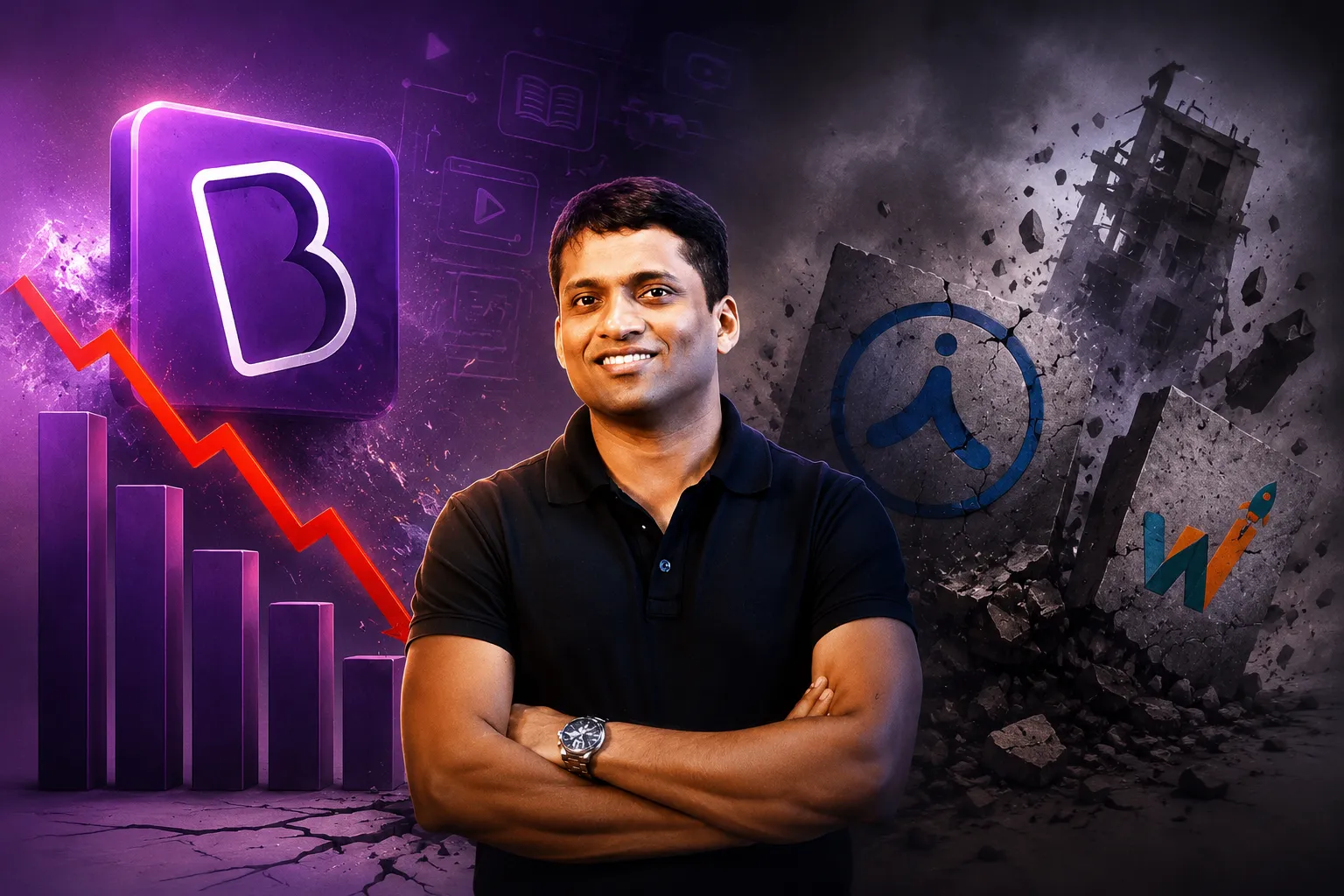
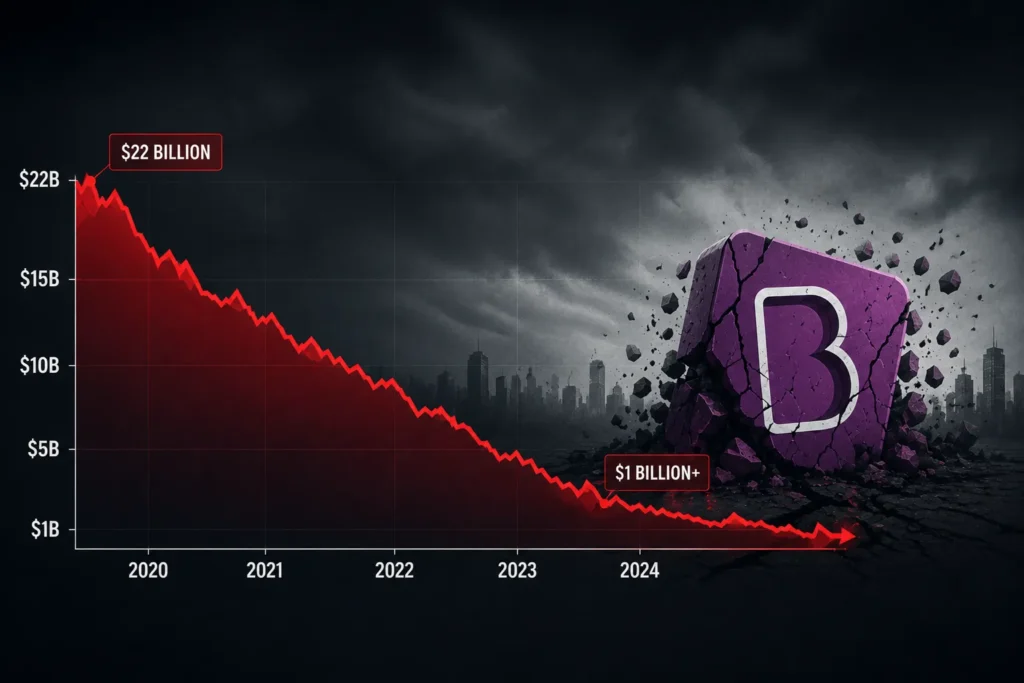
In 2022, Byju’s was worth $22 Billion. It was the most valuable edtech startup on the planet. Backed by some of the biggest names in global investing — Tiger Global, Chan Zuckerberg Initiative, Sequoia, BlackRock. Over 150 million app downloads. A founder who appeared on stage with world leaders and graced the covers of business magazines.
By October 2024, that same founder — Byju Raveendran — publicly said three words that shocked India’s entire startup world:
“The company is worth zero.”
Byju Raveendran’s personal net worth, once valued at $2.1 Billion in 2022, has dropped to zero according to Forbes’ 2024 Billionaires List.
This is not just a startup failure story. This is the most dramatic collapse in Indian business history — a cautionary tale about what happens when ambition completely disconnects from financial discipline, governance, and basic common sense.
In this article you will learn how Byju’s went from a brilliant teaching idea to a $22 Billion giant, why it all fell apart, what the real numbers looked like behind the scenes, and what every entrepreneur building in India must take away from this story.
Let’s start from the very beginning.
Background and Origin Story: The Teacher Who Built an Empire
Byju Raveendran is not your typical founder. He did not come from IIT or IIM. He grew up in Azhikode, a small coastal town in Kerala, in a family of school teachers. His parents were both teachers. Education was the air he breathed.
After completing his engineering degree, he worked briefly as a service engineer for a shipping company. But his real gift was always teaching. Friends would ask him to explain concepts. Strangers would ask him to coach them for entrance exams.
In 2003, he started informally teaching friends who were preparing for the CAT — the entrance exam for India’s top MBA colleges. His methods were unusual. He used real-world examples, stories, analogies — pizza to explain fractions, cricket to explain probability. Students understood things they had struggled with for years.
Word spread fast. His classes grew from 10 people to hundreds to thousands. He was renting stadiums and auditoria across India to run his CAT coaching sessions.
In 2011, he founded Think and Learn Private Limited — the company that would launch the Byju’s app. His wife Divya Gokulnath, also a former student who later became his co-founder, joined him in building the company.
The app launched officially in August 2015 with video-based learning for students from Class 4 to Class 12. The content was high quality, engaging, and genuinely different from the dry textbook style of traditional Indian education.
Parents noticed. Students liked it. And investors started paying attention.
The Growth Story: From a Teaching App to a $22 Billion Giant
2015 to 2019: Building the Foundation
The early years were about building a product that actually worked.
Byju’s was launched in August 2015, offering educational content for students from Classes 4 to 12, with an early learning program starting for Classes 1 to 3 in 2019. It also trained students for IIT-JEE, NEET, CAT, IAS, and international examinations such as GRE and GMAT.
The business model was freemium — students could access content free for 15 days, after which a paid subscription was required. The sales model was aggressive, with a large on-ground team visiting homes to demonstrate the app and close subscriptions.
By 2019, Byju’s had secured nearly $785 Million in funding from investors including Sequoia Capital India, Chan Zuckerberg Initiative, Tencent, Lightspeed Venture Partners, and General Atlantic.
Revenue was growing fast. In 2017, Byju’s earned approximately $40 Million. By 2018 it had doubled to around $80 Million. The product was real. The growth was real. The story made sense.
2020: COVID Changes Everything
Then the pandemic arrived. And Byju’s turned into a rocket ship overnight.
Schools shut across India. Parents desperately needed online learning solutions for their children. Byju’s was already there, already trusted, already on millions of phones.
In June 2020, Byju’s attained decacorn status with a $10.5 Billion valuation following investment from Bond Capital.
Money started pouring in from every direction. Global investors who had been watching India’s edtech space suddenly wanted in. Byju’s raised round after round at higher and higher valuations.
In November 2020, Byju’s raised $200 Million from BlackRock and T. Rowe Price at a $12 Billion valuation. In March 2021, it secured $460 Million in a Series F round. In April 2021, B Capital, Baron Funds, and XN invested $1 Billion more.
In March 2022, Byju’s raised $800 Million more — reaching a peak valuation of $22 Billion. The world’s most valuable edtech company. An Indian startup at the very top of the global education technology world.
This is where the story should have been perfect. This is where it started going very wrong.
2021 to 2022: The Acquisition Spree
With billions in the bank and investor confidence at its peak, Byju Raveendran made a decision that would ultimately destroy the company — he went on a massive buying spree.
In rapid succession, Byju’s acquired over 20 companies. The biggest ones were Aakash Educational Services — India’s largest offline test preparation chain — for approximately $1 Billion. WhiteHat Jr — a coding education startup for children — for $300 Million. Epic — a US-based children’s digital reading platform — for $500 Million. Toppr and HashLearn and Great Learning and dozens more.
The total spent on acquisitions exceeded $2.5 Billion in just two years.
The logic seemed sound on paper — build a complete education empire, dominate every segment, become the Amazon of learning globally.
The execution was a disaster.
Each acquired company had its own culture, its own technology, its own team. Integrating them was enormously complex. Many acquisitions were made at valuations that looked insane even at the time. WhiteHat Jr alone was bought for $300 Million and later reported to have been worth a fraction of that.
The costs multiplied. The revenues did not keep pace. And Byju’s had taken on $1.2 Billion in debt from international lenders to fund part of this expansion.

The Business Model: Where the Money Went
How Byju’s Made Money
Byju’s primary revenue came from selling annual and multi-year subscriptions to its learning app. Prices ranged from Rs 10,000 to Rs 80,000 per year depending on the grade and course. A large sales force would visit homes across India — sometimes using aggressive tactics — to convince parents to sign up.
Revenue was real and growing. In FY2022, Byju’s reported revenues of approximately Rs 5,300 crore — its highest ever.
But the costs were catastrophic.

Where the Money Was Actually Going
Marketing and brand building consumed enormous capital. Byju’s was the jersey sponsor of the Indian cricket team — one of the most expensive sponsorships in Indian sports. They ran ads everywhere, constantly.
The sales force was massive and expensive. Thousands of salespeople across hundreds of cities, each earning salaries and commissions.
Acquisition costs were staggering — over $2.5 Billion spent buying companies at peak valuations.
And the acquired companies themselves were burning cash. WhiteHat Jr had enormous teacher costs. Epic was a US business with US cost structures. Aakash had hundreds of physical centres to maintain.
The result — Byju’s was losing enormous amounts of money every year while telling investors and the public that profitability was just around the corner.
The Role of Technology
To be fair, Byju’s technology was genuinely good. Their animated video content explaining complex concepts was among the best in Indian edtech. Their personalized learning paths adapted to individual student performance. Their live tutoring platform connected students with expert teachers in real time.
AI was used to identify where students were struggling, recommend content, and adjust difficulty levels automatically. This was real and valuable technology.
The problem was never the product. The problem was the business wrapped around the product.
Key Lessons For Entrepreneurs: What Byju’s Teaches Us
Lesson 1: Acquisitions Don’t Build Companies — Operations Do
Byju’s bought over 20 companies in two years. But buying a company is the easy part. Integrating it, running it profitably, and making it work with your core business — that is the hard part.
WhiteHat Jr teachers were quitting. Epic was a US product being run from India. Aakash’s offline model was completely different from Byju’s online approach. None of these integrations went smoothly.
Every rupee spent on acquiring a company is a rupee not spent on making your core product better. Acquisitions should strengthen what you already do well — not replace the hard work of building operational excellence.
Lesson 2: Revenue Is Vanity, Profit Is Sanity, Cash Is Reality
Byju’s had impressive revenue numbers. But their cash was disappearing faster than it was coming in. They delayed filing financial reports — their FY2021 results were filed over a year late. When the numbers finally came out, the losses were shocking.
Deloitte resigned as Byju’s auditor, and multiple board members exited the company. When your auditor walks out, that is not a small sign. That is a fire alarm.
Any entrepreneur must obsess over cash flow — not just revenue. How much cash is actually in the bank today? How many months can you operate at current burn rate? If you cannot answer these questions clearly at any moment, your business is in danger.
Lesson 3: Governance Is Not Bureaucracy — It Is Survival
A Delaware bankruptcy court found that Raveendran had repeatedly ignored court orders and provided evasive, incomplete responses regarding $533 Million that Byju’s US unit allegedly transferred in 2022 and never recovered.
This is the detail that takes Byju’s from a sad business failure to something far more serious. Missing financial reports is bad governance. Auditors resigning is bad governance. But $533 Million allegedly transferred to a little-known Miami hedge fund and then not accounted for — that is a governance catastrophe.
Investors gave Byju’s billions because they trusted the founder. That trust was broken completely. No startup survives when trust is gone.
Challenges and Setbacks: The Collapse in Detail
The Financial Reporting Disaster
By 2022, alarm bells were ringing. Byju’s had still not filed its FY2021 financial results — over a year after the period ended. When the results finally arrived, they showed losses of Rs 4,564 crore for FY2021 on revenue of Rs 2,428 crore. The company was losing nearly twice what it was earning.
Deloitte — one of the world’s most respected accounting firms — resigned as Byju’s auditor. Three independent board members also resigned. These are not small events. These are major red flags that the company’s finances were not in order.
The Layoffs
What followed was painful. Byju’s laid off thousands of employees across multiple rounds. Sales teams were cut. WhiteHat Jr teachers lost jobs. Support staff across acquired companies were let go.
In 2024, the company laid off approximately 500 more employees, mainly from its sales and marketing departments.
For thousands of Indian families who had joined Byju’s during the boom years believing they were part of something historic — this was devastating.
The Legal Battles
On January 25, 2024, lenders began bankruptcy proceedings against Byju’s in India. On February 1, 2024, Byju’s US division filed for Chapter 11 bankruptcy in Delaware.
$533 Million was allegedly transferred from Byju’s Alpha to Camshaft Capital, a little-known Miami-based hedge fund. Lenders went to court to recover their money. The legal battles spread across India, the USA, and multiple other jurisdictions simultaneously.
The company is now mired in lawsuits, funding droughts, mass layoffs, and a battle for control as lenders and creditors race to recover what they can.
The App Goes Dark
In May 2025, the Byju’s Android app was delisted from the Google Play Store due to unpaid AWS bills.
A $22 Billion company could not pay its cloud computing bills. That one sentence summarises how completely things fell apart.
Where Are They Now: Byju’s in 2026
The situation today is grim and deeply complicated.
As of 2025, Byju’s is under insolvency proceedings in India with early bidders including Manipal Education and Medical Group and Ronnie Screwvala’s UpGrad.
A US court issued a default judgment making Byju Raveendran personally liable to pay back over $1.07 Billion based on a petition filed by Byju’s Alpha and US-based lender GLAS Trust. Raveendran has said he will appeal this judgment and denies wrongdoing.
Aakash Educational Services — the most valuable acquisition Byju’s made — is fighting its own legal battles over ownership and control, with the matter being heard by Indian courts.
Byju’s owns GeoGebra — the international mathematics software platform — which remains one of the few genuinely valuable assets left in the wreckage.
The brand that once sponsored India’s cricket team, ran ads during every IPL match, and claimed to be building the future of education for a billion Indian children is today a name associated with bankruptcy courts, missing funds, and broken promises.
Conclusion: The Real Byju’s Lesson
Byju Raveendran is genuinely brilliant. The original product was genuinely good. The vision of making quality education accessible to every Indian child was genuinely noble.
But brilliance without discipline is dangerous. Vision without governance is catastrophic. And growth without financial honesty is not growth at all — it is a slow-motion collapse dressed up in a good story.
The Byju’s collapse teaches us something that no business school lecture can fully convey — that the fundamentals of business are not boring accounting details. They are the difference between building something that lasts and building something that falls apart the moment the money stops flowing.
Fast growth is exciting. Sustainable growth is everything.
Build something real. Report your numbers honestly. Treat your investors’ trust as the most precious thing you have. And remember that the bigger you grow, the more dangerous it is to ignore the basics.
Byju’s ignored all of it. And a company that was once worth $22 Billion is today worth, in the founder’s own words — zero.
Want to read more Indian startup stories like this? Head over to bizfromzero.com for real, honest breakdowns of how India’s biggest companies were built — and sometimes broken.
