What would you do if your salary was good, your job was secure, and you were working at one of the most respected companies in the world?
Most people would stay comfortable. Sachin Bansal and Binny Bansal did the opposite.
In 2007, both of them were working at Amazon — the company that had already cracked online shopping in the USA. They had stable jobs, good salaries, and a clear career path. But they kept asking one question that wouldn’t leave their heads:
If Amazon works so well in America, why isn’t anyone doing this in India?
That question became Flipkart.
Today, Flipkart is valued at over $200 Billion and is India’s largest e-commerce platform. It was sold to Walmart for $16 Billion in 2018 — the biggest e-commerce acquisition in history at that time.
But the journey from a Bangalore apartment to a $16 Billion exit wasn’t straight. It was full of self-doubt, supply chain nightmares, funding rejections, and one genius insight that changed everything — Cash on Delivery.
In this article you will learn how Flipkart started from nothing, the one decision that cracked the Indian market open, how they went from selling books to becoming India’s everything store, and the real lessons every Indian entrepreneur can take from this story.
Let’s go back to the beginning.
Background and Origin Story: Two IITians Who Bet on India
First, let’s clear one common confusion — Sachin Bansal and Binny Bansal share the same last name but are not related. They were classmates at IIT Delhi, one of India’s most prestigious engineering colleges.
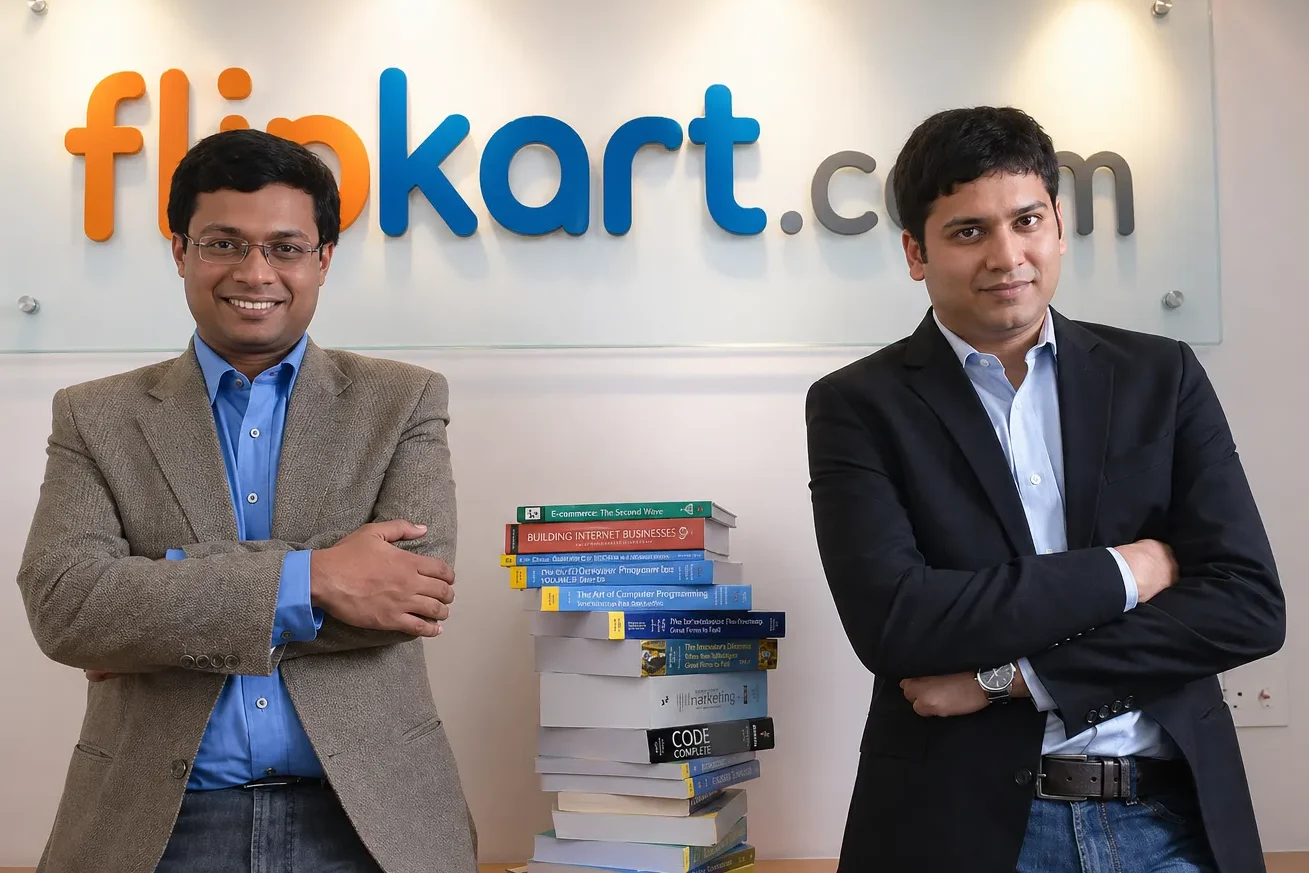
After graduating, both joined Amazon’s India operations. They got a front-row seat to how e-commerce worked — the logistics, the cataloguing, the customer experience, and the technology backend.
By 2006-2007, they were watching Amazon grow in the USA and kept thinking — India has over a billion people, the middle class is expanding, internet is slowly spreading. Why isn’t someone building this here?
What India Looked Like in 2007
The India of 2007 was very different from today. Smartphone penetration was near zero. Broadband existed only in big cities and was slow and expensive. Credit card penetration was under 5%. Most Indians had never bought anything online — ever. There was no real trust in giving money to a website you couldn’t see or touch.
This was the environment Sachin and Binny walked into.
Most people called it a bad idea. Indians don’t trust online payments. Indians want to touch and feel products. The market isn’t ready.
Sachin and Binny heard all of this. And they started anyway.
The First Day
In October 2007, Flipkart was registered as a company. The founding capital was just $6,000 — money saved from their Amazon salaries.
Why books? Because books were easy to source, standard products with no size or colour confusion, high in demand, and easy to ship.
They set up in a small apartment in Koramangala, Bangalore. They built the website themselves. They negotiated with distributors themselves. When orders came in, they packed books themselves and delivered them on their own motorcycles across Bangalore.
This was not a fancy funded startup. This was two engineers doing everything from scratch — because they had to.
The Growth Story: From Books to India’s Everything Store
2007 to 2009: Surviving on Grit
The first two years were about survival. Orders were small. The website was basic. There was no marketing budget. Most customers came through word of mouth.
But Sachin and Binny were obsessive about one thing — customer experience. Every order had to arrive on time. Every complaint had to be handled personally. This obsession built something money can’t buy — trust.
By 2008, daily orders grew from single digits to dozens. The team expanded from 2 people to around 10.
The Genius Move: Cash on Delivery
Here is the moment that changed everything.
By 2009-2010, Flipkart figured out that the biggest barrier to e-commerce in India was not the technology. It was not the website. It was trust in payment.
Indians were not going to type their credit card details into a website and hope for the best. The culture of cash was deeply embedded. People wanted to see the product before paying.
So Flipkart introduced something that seems obvious in hindsight but was genuinely revolutionary at the time — Cash on Delivery.
You order online. The product arrives at your door. You pay cash when you receive it.
This was not a technical innovation. It was a cultural insight.
Sachin and Binny understood that to build e-commerce in India, you had to build it for India — not copy-paste the American model where everyone had a credit card.
Cash on Delivery exploded Flipkart’s growth. Orders multiplied. Categories expanded. What started as a books website was now a full marketplace.
2010 to 2012: The Funding Arrives
With Cash on Delivery proving that Indian e-commerce worked, investors began paying attention.
In 2010, Flipkart raised $1 Million from Accel Partners — their first significant external funding. In 2011, Tiger Global invested $10 Million, then $20 Million more. By 2012, multiple rounds brought total funding to over $150 Million.
What did they do with this money? They built infrastructure. Warehouses. Logistics networks. Their own delivery fleet. Technology teams.
This was the critical decision that separated Flipkart from imitators — they didn’t just build a website. They built the entire ecosystem that Indian e-commerce needed to function.
At a time when courier companies were unreliable, Flipkart built Ekart — their own logistics arm — to control quality from order placement to final delivery.
2013 to 2014: Big Billion Days and the Amazon War
By 2013, Flipkart had expanded into electronics, fashion, home goods, and more. They were no longer a books website — they were India’s most trusted online shopping destination.
Then came Big Billion Day on October 6, 2014. Flipkart announced India’s first flash sale — massive discounts for one day only. The response was so overwhelming that their servers crashed within hours. It was simultaneously their biggest success and biggest embarrassment.
Millions of Indians who had never shopped online tried Flipkart that day. Despite the technical disaster, it planted Flipkart in the national consciousness.
This was also the year Amazon launched aggressively in India. The competitive war began — two well-funded companies fighting for the same Indian consumer.
Flipkart’s response was bold. They acquired Myntra — India’s leading fashion e-commerce platform — for approximately $300 Million in 2014.
2015 to 2017: Billion-Dollar Valuations and PhonePe
In 2014, Flipkart raised $1 Billion in a single round — a historic milestone. By 2015, valuation crossed $15 Billion. In 2016, they raised another $700 Million from Tencent, Microsoft, and eBay.
In 2016, Flipkart also launched PhonePe — a UPI-based digital payments platform. PhonePe would later become one of India’s most downloaded apps and is today valued separately at over $12 Billion.

By 2017, Flipkart had over 100 Million registered users, more than 100,000 sellers on the platform, and a team of over 30,000 employees.
The Business Model: How Flipkart Actually Makes Money
The Marketplace Model
Flipkart operates primarily as a marketplace — they don’t own most of the products sold on their platform. Instead, they connect buyers with third-party sellers and take a commission — typically 5% to 20% depending on the product category.
Think of it like a mall. Flipkart owns the mall. Sellers rent space in it.
Revenue Streams
Commissions from sellers is their primary income. Every sale generates a percentage fee. Electronics might earn a 5% cut. Fashion might earn 20%.
Advertising is the second big stream. Sellers pay Flipkart to appear higher in search results or on banner ads. Those “Sponsored” tags you see on product listings — those sellers are paying for that spot. This is high-margin and growing fast.
Flipkart Wholesale serves kirana stores and small businesses on the B2B side — a massive untapped market in India.
PhonePe, now a separate entity, handles UPI payments, insurance, and investments — all high-margin financial services.
The Role of AI and Technology
Flipkart invests heavily in Artificial Intelligence across the entire business.
When you open Flipkart, the products you see are not random — AI analyses your past browsing and purchases to show what you’re most likely to buy. Prices change multiple times a day based on demand and competitor pricing — all driven by algorithms. AI also predicts where demand will spike and pre-positions inventory in nearby warehouses to reduce delivery time. Fraud detection happens in real time. And Flipkart’s image search feature lets you upload a photo and find matching products — powered entirely by AI.
How They Manage Capital
Flipkart has been funded by SoftBank, Tiger Global, Accel, Tencent, Microsoft, and eventually Walmart. After the Walmart acquisition, Flipkart benefits from Walmart’s global supply chain expertise and financial resources — allowing them to operate at a loss while building long-term market share.
Key Lessons For Entrepreneurs: What Flipkart Teaches Us
Lesson 1: Solve the Indian Problem with an Indian Solution
The insight that built Flipkart was not technology. It was cultural understanding.
Cash on Delivery was not a feature. It was a fundamental rethinking of how e-commerce had to work for Indian consumers. Sachin and Binny didn’t try to educate Indians to trust online payments. They removed the need for trust entirely.
Every entrepreneur building for India needs to ask — am I solving this problem in the way my actual customer thinks, or in the way I think they should think? The gap between these two answers is where most Indian startups fail.
Lesson 2: Control the Experience, Even When It’s Expensive
Flipkart didn’t just build a website. They built Ekart.
When third-party courier companies were failing their customers, Flipkart made the expensive decision to build their own logistics arm. This cost enormous money. But it gave them control over the customer experience — which is everything in e-commerce.
Own the parts of your business that directly touch your customer. Everything else can be outsourced.
Lesson 3: Don’t Be Afraid of Big Bets
Flipkart’s acquisition of Myntra for $300 Million looked risky at the time. In hindsight, it gave them dominance in fashion — the fastest-growing e-commerce category in India.
They also bet on PhonePe before UPI was mainstream. That bet is now worth over $12 Billion on its own.
Big companies are built by people willing to make bets that look crazy before they look obvious. If your idea feels completely safe, it probably isn’t big enough.
Challenges and Setbacks: The Struggles Behind the Success
The 2015 Valuation Crash
At its peak in 2015, Flipkart was valued at $15 Billion. Then investors including Morgan Stanley and T. Rowe Price publicly marked down their Flipkart stakes — suggesting the real value was significantly lower.
This raised serious questions about whether Flipkart had grown too fast and spent too recklessly. The company went through a difficult period of cost-cutting and leadership restructuring.
Big Billion Day Disaster
The 2014 Big Billion Day became a PR nightmare. Servers crashed. Promised discounts were pulled mid-sale. Sellers raised prices before applying discounts to fake the deals. Customers were furious.
To their credit, Sachin and Binny sent a personal apology email to customers and improved their infrastructure dramatically before the next sale.

The Amazon Threat
When Amazon entered India in 2013, they committed $5 Billion to the market. Amazon had deeper pockets, more global experience, and ruthless execution.
Flipkart found itself in a war it couldn’t win purely on capital. This is one key reason why the Walmart acquisition in 2018 made strategic sense — Flipkart needed a partner with the scale to compete with Amazon globally.
Leadership Turbulence
Sachin Bansal stepped down as CEO in 2016. Binny Bansal later exited after the Walmart acquisition following a personal conduct investigation, which he denied. The founders who built Flipkart were no longer running it.
This is a painful but common reality in high-growth startups — the skills needed to start a company are different from the skills needed to scale it.
Where Are They Now: Flipkart in 2025
Since Walmart’s $16 Billion acquisition in 2018, Flipkart has continued to grow as a subsidiary of the world’s largest retailer. Its valuation has been estimated at over $35 Billion in recent years. The planned IPO — when it happens — is expected to be one of the biggest in Indian stock market history.
PhonePe, spun out of Flipkart and independently funded, now has over 500 Million registered users. It held a 48% market share of UPI transactions at its peak and is valued at over $12 Billion.
Today Flipkart competes directly with Amazon India in every major category, operates Flipkart Minutes for quick commerce delivery, runs Flipkart Wholesale for B2B retail, and owns Myntra — India’s largest fashion platform.
The Indian e-commerce market is expected to reach $350 Billion by 2030. Flipkart intends to own a major share of that.
Conclusion: The Real Flipkart Lesson
The Flipkart story is not really about e-commerce. It’s about two people who trusted their instinct about their own country.
Every expert said Indians won’t shop online. Every expert said the market wasn’t ready. Sachin and Binny ignored the experts and listened to the actual Indian consumer.
They didn’t copy Amazon. They built something Amazon could not have built — because Amazon didn’t understand that in India, trust is built differently. Not with technology. With a delivery person knocking on your door and waiting while you open the package.
That’s Cash on Delivery. That’s the insight that built a $200 Billion company.
If you’re building a startup in India today, the most important question you can ask is not how do they do this abroad — it’s how does my actual Indian customer think, feel, and behave?
Build for that person. Not for the textbook. Not for the pitch deck.
That’s the real lesson from Flipkart.
Want to read more Indian startup stories like this? Head over to bizfromzero.com for more deep-dives into how India’s biggest companies were built from zero.